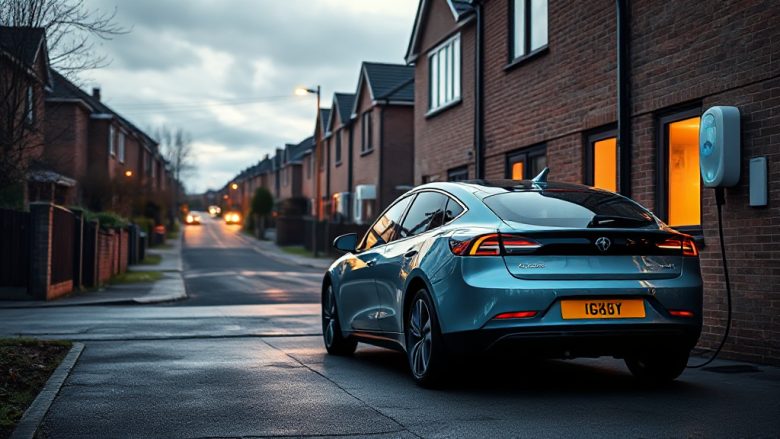
You do the same drive five days a week. Maybe it is twelve miles of stop-start city traffic, maybe it is forty miles of dual carriageway with a wind farm on the horizon. Either way, the question that keeps nagging at you is simple: do I keep filling up at the pump, or do I plug in at home and never think about petrol again? I have run both types of car side by side for years, and the honest answer is that the electric car pros and cons for daily driving depend almost entirely on your routine, not on the badge on the bonnet.
Most people who ask me about this are not enthusiasts. They are commuters who want a car that starts every morning, costs less to run, and does not turn a simple trip to the shops into a logistics exercise. So let us look at where an EV genuinely wins, where it genuinely frustrates, and who should probably wait.
Pros: Running Costs That Quietly Add Up
The first thing you notice when you switch is how little you spend on energy. Charging at home on a standard overnight tariff costs a fraction of what a tank of petrol does. I worked it out on my own commute, roughly thirty miles a day, and the difference was not marginal. It was the kind of gap that changes how you plan your month.
Servicing is the other quiet saving. There is no oil to change, no spark plugs, no exhaust to rot through, and regenerative braking means your friction brakes last far longer than they do on a petrol car. My first EV went three years before it needed anything beyond tyres, wiper blades and a cabin filter. That is not a sales pitch, it is just what the maintenance schedule looks like when half the moving parts are gone.
There is a catch, and it is worth being blunt about it. Those savings only appear if you can charge at home or at work. If you rely on public rapid chargers at peak rates, the running cost advantage shrinks fast, and on some networks it can disappear entirely. The maths is not universal. It is personal.
Pros: Convenience and Comfort in Everyday Use
Here is the part that surprised me most. I expected to miss the noise and the gear changes. I did not. What I actually appreciated was how effortless the car became in ordinary conditions.
An electric car is always ready. There is no cold-start roughness on a January morning, no waiting for the engine to warm up before the heater works properly. You get in, it is quiet, and the torque is there the instant you touch the pedal. In heavy traffic that smoothness is genuinely restful. One-pedal driving, where the car slows itself as you lift off, turns a tedious queue into something almost relaxed.
Preconditioning is the feature I would miss most if I went back. On a frosty morning I can set the cabin to warm and the windows to defrost while the car is still plugged in, so I am not scraping ice or burning range to heat the interior. The same trick works in summer, cooling the car before I get in. It sounds small. It is not small when you do it every working day.
And then there is the filling-up ritual. With a home charger, you stop going to petrol stations. You plug in when you get home, wake up to a full battery, and that errand simply vanishes from your week. That is the convenience argument in one sentence, and for a lot of drivers it is the whole reason they switch.
Cons: The Charging Reality Nobody Warns You About
Now the other side. If you cannot charge at home, daily driving an EV becomes a different and more demanding experience. This is the single biggest factor, and it decides whether the whole thing works for you.
Public charging is improving, but it is still inconsistent. You will find a rapid charger that works perfectly, and the next one on your route will be occupied, out of service, or behind a barrier that needs an app you have not downloaded. Cable thickness varies. Payment methods vary. Some sites are well lit and clean, others feel like an afterthought behind a service station.
Even when everything works, rapid charging is not instant. A realistic stop is twenty to forty minutes depending on the car and the charger, and that is fine if you are grabbing a coffee on a long trip. It is far less fine when you just want to get home after a late shift.
There is also the etiquette question. Charging bays get blocked by cars that are full but not moved, and on a busy weekend that can turn a simple top-up into a wait. None of this is fatal. All of it is friction, and friction is what wears you down over months of daily use.
Cons: Range, Weather and the Honest Numbers
The range figure on the brochure is not the range you will see in February. Cold weather reduces usable range noticeably, because the battery is less efficient and you are asking it to heat the cabin as well as move the car. Expect a meaningful drop in winter, and plan around it rather than being annoyed by it.
Motorway speeds hurt range too. An EV that comfortably covers its claimed distance around town will fall short at a steady seventy miles per hour, because aerodynamic drag rises sharply with speed. This is not a flaw unique to electric cars, but it is more noticeable because you are watching a percentage rather than a fuel gauge that hides the same effect.
For most commuters this never becomes a problem. If your daily drive is under a hundred miles and you charge at home, you will rarely think about range at all. The trouble starts when your routine includes regular long trips, unpredictable detours, or a workplace with no charging provision and no easy alternative nearby. That is when the planning burden becomes real.
Total Cost of Ownership: Where the Numbers Land
Purchase price is the headline that puts people off, and it is fair to say an equivalent electric car usually costs more up front than a petrol one. But daily driving is a long game, and the running costs chip away at that gap month after month.
Add it up over several years and the picture shifts. Cheaper energy, lower servicing, longer brake life and, in many places, reduced or zero annual road tax all work in the EV’s favour. Against that, you have to weigh higher insurance in some cases, the cost of a home charger installation, and faster depreciation on certain models as the market matures.
The honest conclusion is that the total cost of ownership depends on how you charge and how long you keep the car. High mileage plus home charging usually favours the EV clearly. Low mileage plus public charging often does not. There is no universal winner, only a winner for your particular pattern of use.
One practical tip: before you commit, look at your actual weekly mileage rather than your worst-case year. Most drivers overestimate how far they travel and underestimate how rarely they need a rapid charger. That single bit of honesty changes the decision more than any specification sheet.
Who Should Not Buy an EV Yet
I would rather tell you plainly than let you find out the hard way. If you live in a flat with no off-street parking and no reliable charging at work, an electric car will likely be more hassle than it is worth for daily driving right now. You would be relying entirely on public infrastructure, and that is still a gamble in many areas.
If your job involves unpredictable long journeys at short notice, or you regularly tow, or you live somewhere with sparse charging coverage, a petrol or hybrid car remains the sensible choice. There is no shame in that. The technology is good, but it is not yet good for every lifestyle.
And if you only drive a few thousand miles a year, the fuel savings may never outweigh the higher purchase price during the time you own the car.
For everyone else, the commute that starts with a full battery and ends with a cheap top-up at home is genuinely hard to beat. The electric car pros and cons for daily driving come down to one question in the end: can you charge where you sleep? Answer yes, and the case is strong. Answer no, and wait a little longer.